How long parging lasts depends on three things: how well it was applied, what it was applied over, and what conditions it has been exposed to since. In Toronto’s climate, a properly installed parging job on a prepared substrate should last 15 to 25 years. Parging done with incompatible materials, over an unprepared surface, or in poor curing conditions can begin failing within two to five years.
That range is wide, and the gap between the low end and the high end is almost entirely within the control of the contractor doing the work. This article explains what drives parging longevity, what causes it to fail early, and how to extend the life of both new and existing parging on a Toronto home.
The Honest Answer on Lifespan
Most parging on Toronto homes that was applied before the 1990s used lime-based mortar mixes that were flexible and well-matched to the concrete block and brick foundations common in that era. Where that original parging has been maintained and has not been subject to persistent moisture, it often performs for 30 years or more.
Parging applied since then has been more variable in quality. The widespread use of pre-mixed Portland cement-heavy mortars, which are harder and less flexible than lime-based mixes, has contributed to a pattern of cracking and delamination within 5 to 10 years on many homes. This is not an inevitable outcome. It is the result of using the wrong materials for the application.
A mason who selects the appropriate mortar composition for the substrate and exposure conditions, prepares the surface correctly, and applies in suitable weather can reasonably expect the work to perform for 20 years or more. That expectation is realistic for parging a foundation wall done to a proper standard.
What Affects How Long Parging Lasts
Mortar Composition
This is the single biggest variable in parging longevity. Mortar that is too hard for the substrate it is applied to will crack under the thermal movement that Toronto foundations experience through the seasons. A foundation wall expands in summer heat and contracts in winter cold. Mortar that cannot flex with that movement develops cracks, which allow water in, which accelerates failure through freeze-thaw cycles.
Appropriate parging mixes incorporate lime at a ratio that gives the coating enough flexibility to accommodate movement without cracking. The right balance depends on the substrate: older soft brick or concrete block requires a softer, more flexible mix than a modern poured concrete foundation. An experienced mason evaluates the substrate before selecting the mix rather than defaulting to whatever pre-mix material is on hand.
Surface Preparation
Parging that is applied over a dirty, loose, or contaminated surface will not achieve the adhesion needed to last. The substrate needs to be free of old failing parging, efflorescence, organic growth, oil, and dust before any new material is applied. On concrete block, this often means wire-brushing or pressure washing the surface and allowing it to dry. Where old parging layers have built up over decades, full removal to the original block is frequently the right preparation step even though it adds time and cost.
A common shortcut is applying new parging over old parging that is partially adhering. The new coat may look sound for a season or two, but it is bonded to a layer that is already failing. When the old layer continues to delaminate, it takes the new coat with it. Proper preparation removes this risk entirely.
Curing Conditions
Parging is a mortar product that requires time and appropriate temperature to cure properly. The acceptable working range is above 5 degrees Celsius, with no freezing temperatures forecast within 48 hours of application. Work done at the margins of that range, or by contractors who push through in cold conditions to meet a schedule, produces parging that has not cured to full strength and is prone to early cracking and delamination.
Humidity also matters. Parging applied to a surface that is too dry in hot summer conditions can cure too quickly, which causes surface cracking before the mortar has developed its full bond. Lightly dampening a very dry substrate before application is standard practice for experienced masons working in summer heat.
Number of Coats
Single-coat parging provides basic surface coverage but is thinner and less durable than a two-coat application. A two-coat system applies a base scratch coat, allows it to partially cure, and then applies a finish coat over it. The result is a more uniform thickness, better adhesion throughout the depth of the coating, and greater resistance to cracking and impact. On foundations that will be exposed to weather for decades, two-coat application is a better investment even though it costs more at the outset.
Drainage and Grading Around the Foundation
Parging on a foundation that is consistently saturated by poor drainage or soil graded toward the house is working against conditions it was not designed to handle on its own. Surface moisture absorbed repeatedly through the parging face accelerates weathering. Water pooling at the base of the foundation wall keeps the lower section of parging in contact with moisture far longer than it should be.
Ensuring downspouts discharge at least two metres from the foundation, that splash blocks are in place, and that soil grades away from the house at a gentle slope reduces the moisture load on the parging and extends its useful life meaningfully. These are maintenance steps a homeowner can address independently without any masonry work.
Whether the Substrate Had Existing Moisture Problems
Parging applied over a foundation with active moisture intrusion is fighting a losing battle. Hydrostatic pressure from saturated soil will push moisture through the block wall regardless of what is on the surface, and that moisture movement causes parging to blister, crack, and delaminate from the inside out. Where moisture issues exist before parging is applied, addressing them first is the correct sequence. Our masonry waterproofing services address the moisture management side before the surface work begins when both are needed.
How to Tell If Your Parging Is Nearing End of Life
Parging does not fail suddenly in most cases. There is typically a progression of signs that it is approaching the end of its useful life. Knowing what to look for allows you to plan repairs before the failure advances to the point where the substrate beneath is exposed to serious damage.
Early Signs
- Hairline cracks running horizontally or diagonally across the parging surface
- Small areas where the surface feels hollow when tapped, indicating delamination has begun behind the face
- Light surface erosion where the texture has worn smooth or slightly pitted
- Efflorescence appearing at cracks or the base of the wall, indicating moisture is moving through
Active Failure
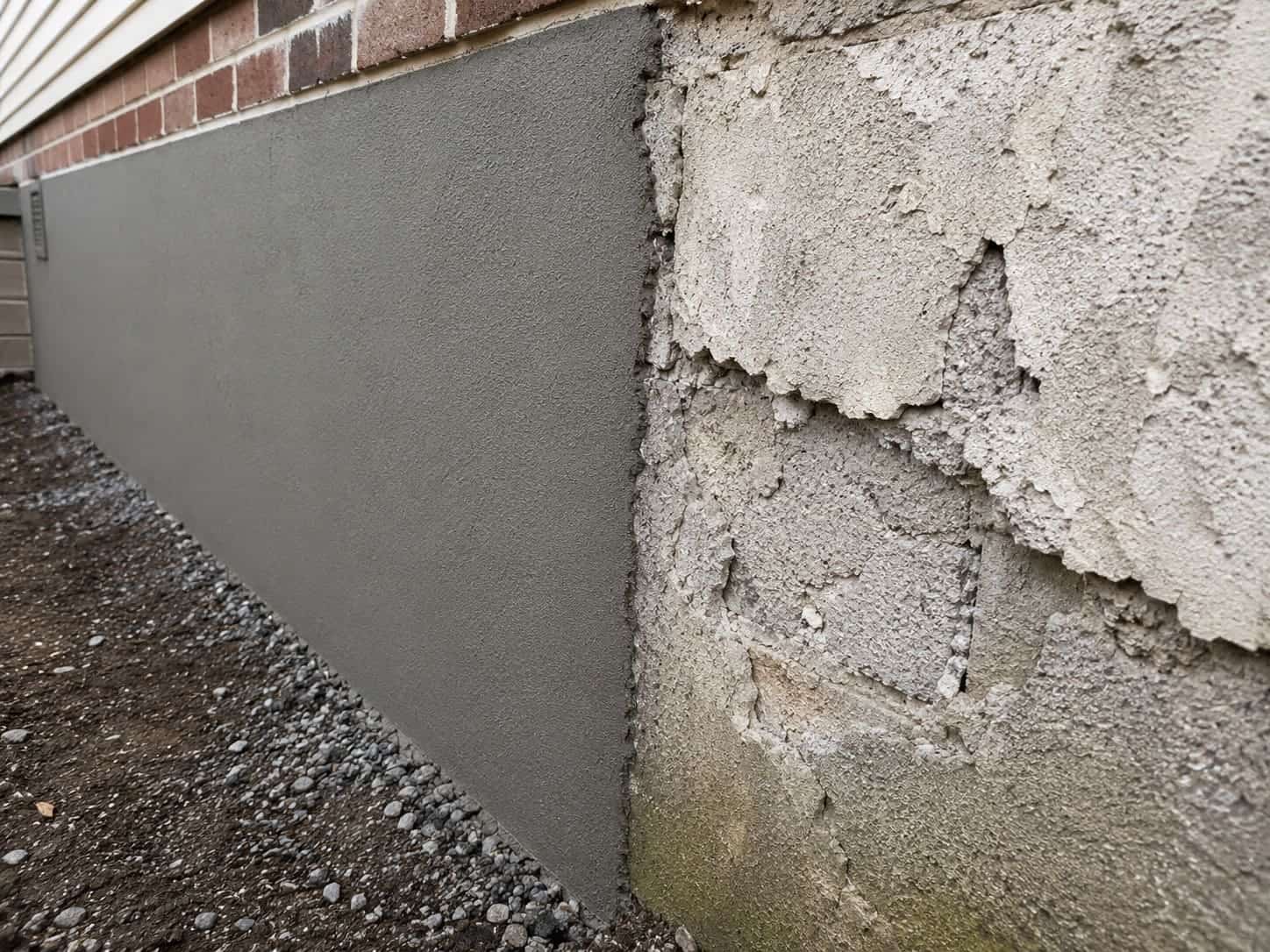
- Sections of parging that are visibly pulling away from the wall or lifting at the edges
- Chunks or sheets of parging that have fallen away, exposing the masonry beneath
- Cracks wide enough to insert a finger or tool
- The exposed block or brick beneath showing visible deterioration, spalling, or staining
At the early sign stage, repair is straightforward and cost-effective. At the active failure stage, a full removal and recoat is usually more appropriate than patching, and the substrate beneath needs to be assessed before new material is applied.
How to Extend the Life of Existing Parging
If your parging is in reasonable condition but showing the early signs of age, a few practical steps can extend its useful life without requiring full replacement.
Address Small Cracks Promptly
A hairline crack that allows water in will widen through freeze-thaw cycling if left alone. Filling small cracks with a compatible mortar or masonry caulk before winter keeps water out and slows the progression of damage. This is maintenance, not repair, and the cost is modest relative to what it prevents.
Keep Drainage in Order
As noted above, the moisture load on parging is heavily influenced by what happens around the foundation perimeter. Clearing blocked downspouts, extending discharge points away from the wall, and maintaining soil grade are all practical steps that reduce wear on the parging surface.
Apply a Penetrating Sealer
A breathable penetrating masonry sealer applied to sound parging helps repel surface moisture without trapping vapour inside the wall. This is distinct from a film-forming coating or paint, which seals the surface in a way that traps moisture and accelerates failure. A penetrating sealer soaks into the parging face and reduces water absorption. It is not a permanent fix for failing parging but it is a reasonable maintenance step on parging that is otherwise in good condition.
Avoid Applying New Parging Over Old Failing Parging
When a contractor proposes applying a new coat directly over existing parging without removing the old material, the result will only last as long as the underlying layer holds. This is a cost-saving shortcut that almost always results in a shorter lifespan than a properly prepared fresh application. If cost is a concern, it is worth discussing whether a full removal and recoat in phases makes more sense than a quick overlay that will need to be redone within a few years.
When to Replace Rather Than Repair
The decision between repairing existing parging and replacing it entirely comes down to how much of the surface is still adhering soundly. If more than 30 to 40 percent of the parging on a wall is delaminating, cracked, or hollow-sounding when tapped, full removal and recoating produces a more durable and uniform result than patching the failed areas and leaving the rest in place.
Patches applied to a broadly failing surface bond to a substrate that is already compromised. The patches themselves may hold for a few seasons, but the surrounding parging continues to fail and the patches are eventually isolated on a surface that needs full replacement anyway. Addressing it comprehensively at the point where failure is widespread is more cost-effective over a 10-year horizon than repeated patching.
If you are unsure which approach makes sense for your foundation, a mason can assess adhesion by sounding the surface systematically. The percentage of the wall that sounds hollow compared to solid gives a reliable picture of whether patching or full replacement is the right scope. For homeowners in the northern GTA, Vaughan masonry services and surrounding areas are covered by our team directly.
What a Quality Parging Job Should Include
If you are planning to have parging done and want work that performs at the longer end of the lifespan range, the following elements should be part of the scope:
- Full removal of existing failing parging down to a clean, stable substrate
- Substrate assessment to identify any masonry repair needed before coating
- Surface cleaning and preparation appropriate to the wall material
- Mortar mix selected for compatibility with the substrate hardness and flexibility requirements
- Two-coat application where conditions and thickness warrant it
- Application in suitable weather with no freezing temperatures forecast within 48 hours
- Adequate curing time between coats and before backfilling or exposure to weather
Work done to this standard routinely performs for 20 years or more. Shortcuts to any of these steps are where the gap between a 5-year result and a 25-year result originates. We are transparent about what our process includes on every project and back our mortar repointing and parging work with a 10-year labour warranty. You can get a quote and ask us exactly what is included before making any commitment.
Frequently Asked Questions About Parging Lifespan
How long does parging last on a Toronto home?
Properly applied parging in Toronto’s climate lasts 15 to 25 years in most cases. The wide range reflects the significant impact of application quality, mortar selection, and surface preparation. Parging done with the right materials on a well-prepared surface consistently performs toward the upper end of that range. Work done with incompatible mixes or inadequate preparation can begin failing in as little as two to five years. Toronto’s freeze-thaw cycle accelerates any existing weaknesses in the application, which is why the quality of the initial work matters more here than in milder climates.
Why does my parging keep cracking?
Recurring cracking is almost always a material compatibility problem. Portland cement-heavy mixes applied to older foundations crack because the mortar is too rigid to accommodate the seasonal thermal movement of the wall. The cracks allow water in, which freeze-thaw cycling widens further. The cycle repeats with each winter. The solution is not applying the same type of parging more frequently. It is using a mortar mix with the right lime-to-cement ratio for the substrate, which gives the coating the flexibility it needs to move with the wall without cracking.
Can parging be applied in sections, or does the whole foundation need to be done at once?
Parging can be done in sections when damage is genuinely localized and the surrounding parging is still adhering soundly. A good patch repair, properly feathered and matched in texture, is a legitimate approach for isolated failure. The practical limit is when failure is distributed across the wall rather than confined to a specific area. At that point, sectional patching produces an inconsistent result and does not address the condition of the parging between the patches. A mason can assess which approach is appropriate for a given wall during an in-person inspection.
Does parging need to be sealed after application?
A penetrating breathable sealer can extend the life of parging by reducing surface water absorption, and applying one after a fresh parging job has fully cured is a reasonable protective step in Toronto’s climate. It is not strictly required for parging to perform well, but it adds a layer of protection at relatively modest cost. The key is using a penetrating sealer rather than a film-forming coating. Film coatings trap moisture inside the masonry, which is the opposite of what you want.
How do I know if my parging was done correctly in the first place?
The most reliable indicators are how it has performed over time and what it looks and sounds like now. Parging that has cracked repeatedly within a few years of application, that sounds hollow when tapped across significant areas, or that is delaminating in sheets rather than weathering gradually was likely applied with incompatible materials or over inadequate preparation. Parging that has held up with minor surface wear over 15 or more years was done to a good standard. If you are evaluating existing parging before a purchase or planning maintenance, having a mason assess it directly is the straightforward way to get a reliable picture.
Should I reparge before selling my home?
If the existing parging is visibly failing, crumbling, or has sections that have fallen away, addressing it before listing is worth considering. Deteriorated parging is noticed by buyers and flagged by home inspectors. It raises questions about deferred maintenance and can become a negotiating point. Fresh parging signals that the exterior is being looked after. The return on the investment is not dramatic, but removing a common inspection objection is a practical benefit. If the parging is aging but still broadly intact with no active failure, it may not be worth the cost of a full replacement before a sale.