Parging and foundation waterproofing are related but they are not the same thing, and choosing one when you need the other will not solve your problem. Both address the foundation, both involve the exterior masonry, and both are commonly recommended when a homeowner notices moisture issues or a deteriorating foundation surface. The confusion is understandable. The distinction, however, matters considerably when it comes to getting the right result.
This article explains what each process does, where they overlap, what problems each one solves, and how to know which one your foundation actually needs.
What Parging Does
Parging is a mortar-based coating applied to the exposed masonry surface of a foundation wall, typically the section that sits above grade and is visible from the exterior. It covers rough or porous masonry, concrete block, or deteriorated original parging with a fresh layer that protects the substrate from direct weather exposure.
The protection parging provides is surface-level. It keeps rain, frost, and UV exposure from making direct contact with the masonry beneath. A sound parging coat slows moisture absorption into the block or brick behind it and gives the foundation a clean, finished appearance. On a foundation in good structural condition with no active water intrusion, foundation parging is often all that is needed to restore and protect the exterior surface.
What parging does not do is stop water that is coming through the wall under pressure. It is a coating on the exterior face of the masonry, not a barrier against moisture that is moving through the wall from the soil side. If water is finding its way into a basement or crawl space, parging the exterior surface will not stop it.
What Foundation Waterproofing Does
Foundation waterproofing addresses moisture that is migrating through the wall from the exterior soil. Water in the ground around a foundation is under pressure, particularly after rain or snowmelt. If the foundation wall has cracks, failing mortar, or porous masonry with no protective membrane, that water moves through and eventually appears on the interior.
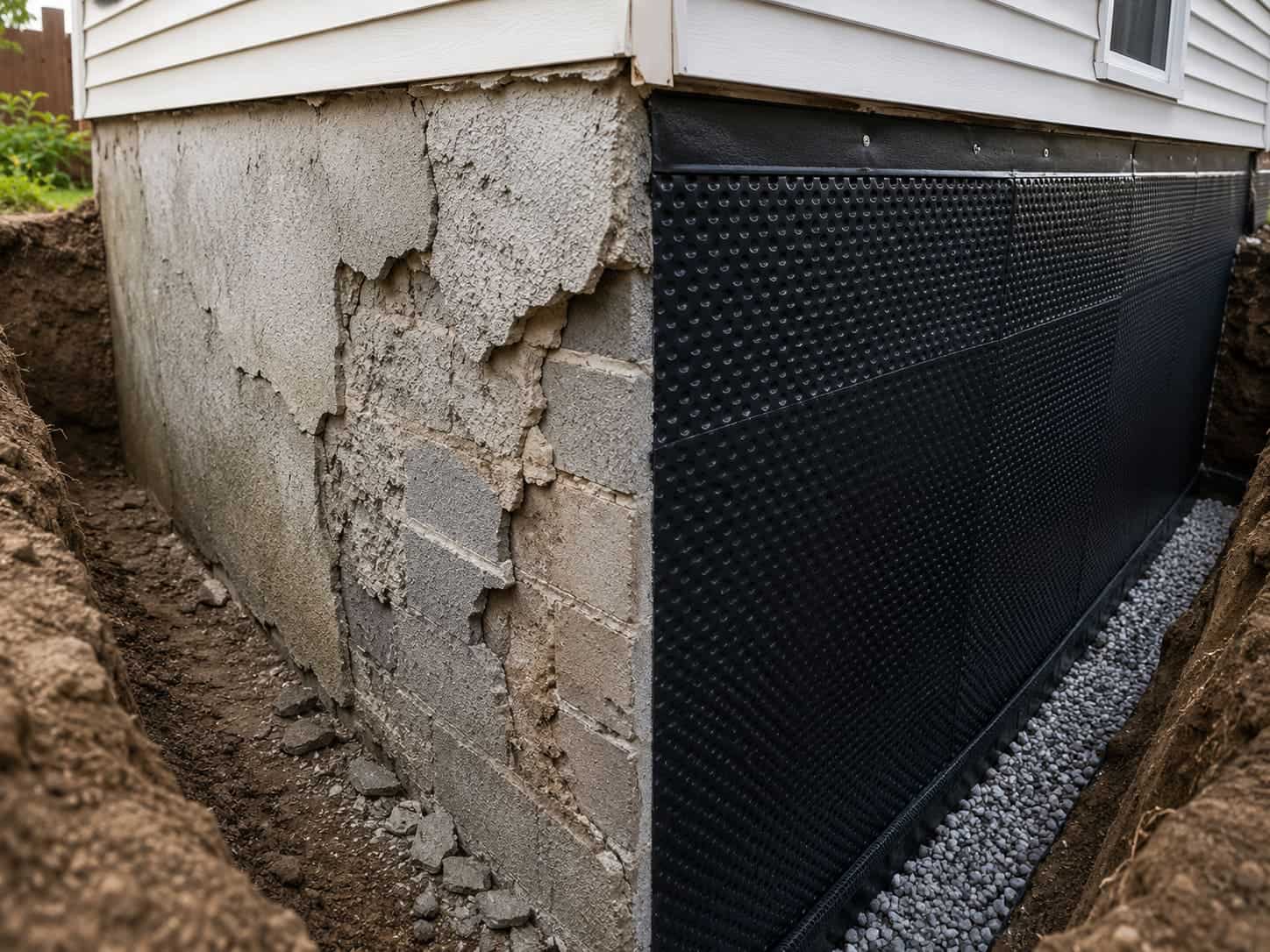
Exterior waterproofing involves excavating around the foundation to expose the wall below grade, cleaning the surface, applying a waterproofing membrane or coating system directly to the foundation wall, and often installing drainage board and a weeping tile system to direct water away from the wall before it builds up against it. This is a more involved scope than parging and addresses the source of water entry rather than the surface condition of the wall above grade.
Our exterior waterproofing service covers membrane application, drainage correction, and the masonry work associated with foundation water management. It is a different project from parging in scope, method, and cost.
Where the Two Overlap
There is a middle zone where both parging and waterproofing are relevant, and this is where most of the confusion originates.
When exterior waterproofing is done, the foundation wall above grade still needs to be finished properly after the work below grade is complete. In most cases, that finish involves parging the exposed section of the foundation. The waterproofing handles the below-grade moisture management. The parging handles the above-grade surface protection and appearance. They work together on the same wall but solve different problems at different heights.
Similarly, a foundation that has visible parging failure may also have moisture issues that go beyond the surface. When old parging falls away and the concrete block beneath has been exposed to moisture for years, the block itself may have deteriorated and the wall may have developed pathways for water entry. In that situation, replacing the parging without assessing whether waterproofing is also needed produces an incomplete repair.
How to Tell Which One Your Foundation Needs
The clearest way to distinguish between a parging problem and a waterproofing problem is to identify where the moisture is and how it is moving.
Signs That Parging Is the Right Scope
- The foundation surface above grade is visibly crumbling, cracked, or peeling
- The exposed masonry is absorbing surface moisture from rain but the basement interior stays dry
- Efflorescence (white salt staining) is present on the foundation face but there is no water on the basement floor or walls
- The parging is failing cosmetically but the block or masonry beneath is still structurally sound
- There is no history of water in the basement and no sign of active moisture intrusion below grade
Signs That Waterproofing Is Needed
- Water appears on the basement floor or walls after heavy rain or snowmelt
- There are visible cracks in the foundation wall that extend through the block or concrete
- Efflorescence is present low on the basement wall or at the floor-wall joint
- There is a history of recurring basement moisture that has not been resolved by interior drainage alone
- The soil around the foundation is poorly drained or graded toward the house
- The home has no weeping tile system or the existing system has failed
Signs That Both Are Needed
- Active water intrusion is present and the above-grade foundation surface has also deteriorated
- Waterproofing excavation has been completed and the foundation needs to be finished above grade
- The parging has failed completely and the exposed block shows signs of moisture damage at multiple levels
- Any waterproofing project that involves restoring the exterior foundation surface to finished condition
Cost Comparison
Parging and waterproofing occupy very different price ranges, which reflects the difference in scope and method.
Parging a standard detached home foundation in Toronto typically costs between $2,000 and $4,500 for a full removal and recoat, or $250 to $1,200 for localized patch repairs. The work is done at the surface and does not require excavation.
Exterior foundation waterproofing involves excavation around the perimeter of the home, which is labour-intensive and requires equipment. A full exterior waterproofing project on a detached Toronto home typically costs between $15,000 and $40,000 depending on the depth of the foundation, the length of the perimeter, and what drainage corrections are included. Partial waterproofing of a specific wall section costs less but still involves excavation on that section.
This cost difference is one reason it matters to diagnose correctly before proceeding. Parging a foundation that genuinely needs waterproofing wastes the parging cost and leaves the moisture problem unresolved. Recommending full exterior waterproofing on a foundation that only needs its surface coating replaced is an unnecessary expense.
What a Proper Foundation Assessment Covers
A proper assessment looks at both the surface condition of the foundation above grade and the evidence of moisture behaviour at and below grade. An experienced mason evaluates the parging condition, the integrity of the masonry beneath, the presence and pattern of efflorescence, any visible cracking, and what the homeowner reports about basement moisture history.
In some cases, the above-grade assessment is sufficient to give a clear recommendation. In others, particularly where basement moisture history is involved, a more thorough evaluation that includes the interior of the basement and the grading and drainage around the perimeter is necessary before a scope can be confidently recommended.
Our foundation repair team approaches assessments this way. We look at the full picture before recommending parging, waterproofing, or a combination of both. If the problem is surface-level, we will tell you. If it is deeper, we will explain that too.
A Common Scenario in Toronto’s Older Housing Stock
Toronto has a large inventory of homes built between the 1940s and 1970s, many of which have concrete block foundations that were originally parged at construction. On these homes, the original parging has often been repaired or recoated multiple times over the decades. By the time a homeowner notices significant failure, there may be two or three layers of old parging on the wall, the outermost of which is delaminating from the layers beneath.
In these situations, removing all of the old material down to the original block is often the right preparation step. What is found underneath determines the scope. A block wall in reasonable condition with no active moisture pathways needs fresh parging. A block wall with cracked joints, deteriorated mortar, or evidence of long-term water movement may need masonry repair, a waterproofing treatment, or both before fresh parging is applied on top.
Homeowners in areas like Etobicoke, North York, Scarborough, and the Durham Region towns frequently encounter this situation with homes from this era. It is not unusual and it is manageable. The important thing is assessing what is underneath before deciding on scope rather than coating over an unexamined substrate.
Frequently Asked Questions About Parging vs. Foundation Waterproofing
Will parging stop water from coming into my basement?
Not if the water is entering through the wall under hydrostatic pressure from the soil side. Parging is a surface coating applied above grade. It protects the masonry face from weather and surface moisture but it is not designed to resist water that is moving through the wall from saturated soil. If you have active water in your basement, parging the exterior above grade will not resolve it. A proper assessment of where the water is entering and how it is moving is the starting point for addressing basement moisture.
Can I get parging done at the same time as exterior waterproofing?
Yes, and in many cases it makes practical sense to do both together. When exterior waterproofing excavation is completed and the wall is backfilled, the above-grade foundation section still needs to be finished. Scheduling parging as part of the same project avoids mobilizing a second crew later and ensures the finished appearance of the foundation is addressed while the work area is already open. Our team handles both scopes directly, so the coordination is straightforward.
My parging is cracking every few years. Does that mean I have a waterproofing problem?
Not necessarily. Parging can crack repeatedly for reasons that are unrelated to moisture intrusion: incompatible mortar mixes, inadequate surface preparation, application in poor curing conditions, or movement in the substrate. If the cracking is at the surface only and the basement stays dry, the issue is likely with the parging application rather than with water management. If cracking is accompanied by moisture in the basement or efflorescence at low points on the wall, a waterproofing assessment is warranted.
Is exterior waterproofing always necessary, or are there alternatives?
Exterior waterproofing is the most thorough solution for persistent foundation moisture because it addresses the problem at its source. Interior drainage systems are an alternative that manages water after it enters the wall rather than preventing entry. They can be effective and are considerably less disruptive than excavation, but they do not stop water from moving through the wall itself. The right approach depends on the severity of the problem, the condition of the foundation, and practical factors like landscaping, access, and budget. A foundation assessment gives you a clear picture of which options apply to your situation.
How do I know if my foundation needs parging, waterproofing, or both?
The starting point is understanding where the moisture is and how it is behaving. Surface deterioration above grade with a dry basement points toward parging. Active water in the basement points toward a waterproofing assessment. Both conditions together suggest both scopes may be needed. An on-site assessment by a mason who looks at the foundation surface, the basement interior, and the drainage conditions around the perimeter gives you the clearest answer. If you are based anywhere in the GTA, including Richmond Hill masonry services coverage area and surrounding communities, you can book a masonry assessment directly with our team.
Does parging count as waterproofing for home insurance purposes?
No. Parging is a surface finish and protective coating, not a waterproofing system as defined by insurers or building codes. If your insurer or a home inspector refers to foundation waterproofing requirements, they are referring to a membrane-based system applied below grade, not to parging. Applying parging to meet a waterproofing requirement will not satisfy that requirement. If you are uncertain what is being asked for in a specific context, clarifying with the requesting party is the straightforward approach.