An interlock driveway is a significant investment, and the first question most homeowners ask is what it will cost. The honest answer is that the price depends on choices you make and conditions at your property, so a single flat rate would be misleading.
This guide explains what drives the cost of an interlock driveway in Toronto, why quotes vary, and how to read an estimate so you can compare fairly. The aim is to help you budget realistically and understand what separates a durable driveway from a cheap one that fails early.
Why Interlock Driveway Prices Vary So Much
Two interlock driveways of the same size can carry very different price tags, and the reason is almost always what lies beneath the surface and which materials are chosen.
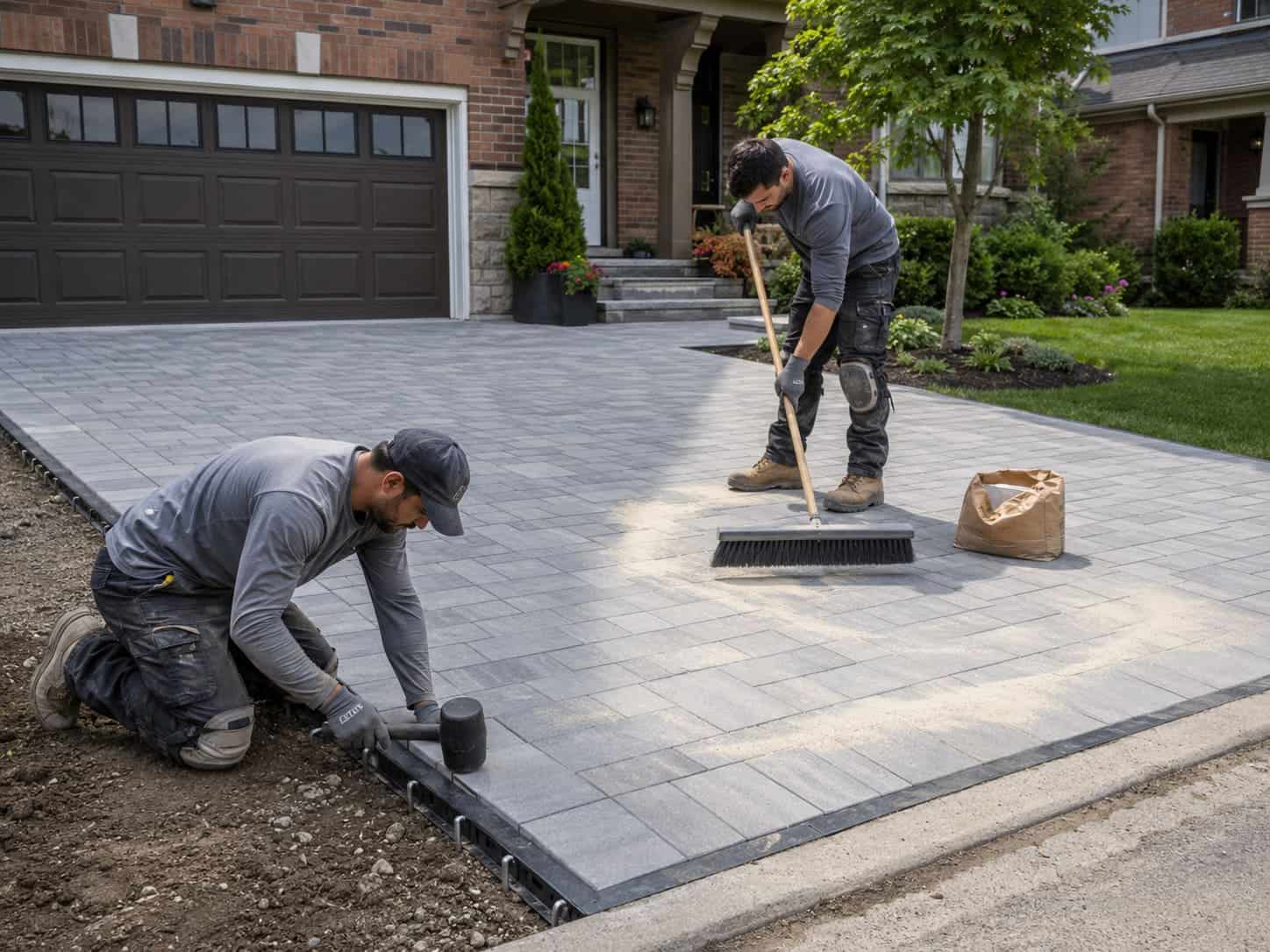
A driveway is far more than the pavers you see. Most of the cost and most of the durability come from excavation, the depth and quality of the base, drainage, edge restraint, and the labour to lay the stone precisely. A quote that looks cheap often achieves it by cutting the base short, which is exactly where a driveway needs strength.
Because of this, the ranges discussed here are meant to frame expectations, not to serve as a quote. Your actual price depends on the specifics of your driveway and your property.
The Main Factors That Affect Cost
Rather than a single number, it helps to understand the variables that push an interlock driveway’s price up or down.
Size and Shape
The square footage is the starting point, but shape matters too. A simple rectangular driveway is more economical than one with curves, multiple angles, or an irregular layout, because complex shapes require more cutting and slower, more careful work.
Material Choice
The paver itself is a major cost lever. Standard concrete pavers are the most economical, premium and designer pavers cost more, and natural stone sits at the top of the range. Permeable systems that manage drainage also carry a different price because of their specific construction.
Base and Site Preparation
Removing an existing driveway, whether asphalt, concrete, or old pavers, adds cost. So does poor soil that needs a deeper base, a sloped lot, or drainage work. This preparation is not where to economise, because it determines whether the driveway lasts.
Pattern and Design Details
Intricate patterns, contrasting borders, banding, and inlays add labour through extra cutting and layout time. A simple field pattern is quicker and cheaper than a detailed design with multiple colours and a decorative border.
Access and Site Conditions
Tight access, obstacles, and limited space for equipment and material handling all slow the work and add labour. A driveway that machines can reach easily costs less to build than one where everything must be moved by hand.
Where the Budget Actually Goes
Understanding how the cost breaks down helps you see why the base is not the place to save money.
- Excavation and disposal. Digging out the area and removing the old surface and soil.
- Base materials and compaction. The aggregate base and the labour to build and compact it in layers.
- Pavers. The stone itself, which varies widely by type and quality.
- Labour to lay and cut. The skilled work of setting, aligning, and cutting the units.
- Edge restraint and jointing. The edging and jointing sand that lock the driveway together.
A well-built driveway spends properly on excavation and base because that is what carries the vehicle load and survives the freeze-thaw cycle. Quality interlock installation puts the investment where it lasts rather than only into what is visible.
How to Read an Interlock Driveway Quote
A good quote tells you more than a price. Knowing what to look for helps you compare estimates on substance.
What a Clear Quote Includes
Look for a quote that specifies the excavation depth, the base depth and material, the paver type and thickness, the pattern, edge restraint, and jointing. When a quote is a single lump sum with no detail on the base or the stone, it is hard to know whether corners are being cut where it matters most.
Questions Worth Asking
- How deep is the base, and is it rated for a driveway rather than a walkway?
- What paver thickness are you using, and is it rated for vehicles?
- How is drainage being handled?
- Is there edge restraint, and what type?
- Is there a warranty, and are you WSIB certified and insured?
The answers reveal whether a contractor is building for longevity or quoting to win on price alone. Experienced Toronto masonry contractors will walk you through these details on site, so a driveway built on a proper base by an insured team is where real value lies.
Why the Cheapest Quote Can Cost More
With driveways, the lowest number is frequently the most expensive choice over time.
A quote that saves money by building a shallow base, skipping edge restraint, or using thin pavers produces a driveway that heaves, ruts, or spreads within a few years. Rebuilding or repairing it then costs far more than the original saving. The difference between a driveway that lasts decades and one that fails early is usually invisible at the surface and entirely in the preparation.
Value comes from a driveway built correctly the first time and maintained over its life. Periodic interlock repair and sealing protects that investment and keeps the surface looking and performing well for years.
Frequently Asked Questions About Interlock Driveway Cost
How much does an interlock driveway cost in Toronto?
There is no single price because the cost depends on the driveway’s size and shape, the paver material, the base and site preparation, and the design details. A simple rectangular driveway with standard concrete pavers on good soil sits at the lower end, while a large or complex driveway with natural stone, intricate patterns, and extensive base work costs considerably more. Because so many variables are involved, a reputable contractor provides a firm figure only after assessing your property. Any number quoted without seeing the site should be treated as a rough estimate.
Is an interlock driveway more expensive than asphalt or concrete?
Interlock typically carries a higher upfront cost than asphalt and is often comparable to or more than poured concrete, mainly because of the materials and the skilled labour to lay the pavers. What that buys is greater durability, easier repairs, and a more attractive, longer-lasting surface. Asphalt is cheaper initially but needs regular resealing and has a shorter lifespan, while poured concrete can crack in the freeze-thaw climate. Many homeowners view interlock as a longer-term value despite the higher initial price.
Why do interlock driveway quotes differ so much?
Quotes vary because much of the cost and quality lies in the base and preparation, which are not visible in the finished surface. One contractor may build a deep, properly compacted base with edge restraint and drainage, while another quotes a shallower base to lower the price. Paver quality and thickness also differ between quotes. This is why comparing only the bottom-line number can be misleading. Reviewing what each quote includes for excavation, base depth, and materials shows whether you are comparing equivalent work.
Does the base really affect the cost that much?
Yes, the base is one of the largest cost components and the single biggest factor in how long the driveway lasts. A driveway must carry vehicle weight and survive repeated freezing and thawing, both of which depend on a deep, well-compacted aggregate base and proper drainage. Cutting the base short lowers the quote but leads to heaving, rutting, and early failure. Spending properly on the base is what makes the difference between a driveway that lasts decades and one that needs rebuilding in a few years.
How long does an interlock driveway last?
A properly built interlock driveway can last several decades, and the pavers themselves are very durable. Longevity depends far more on the quality of the base, correct paver thickness, edge restraint, and drainage than on the stone alone. Occasional maintenance such as re-sanding the joints and periodic sealing helps preserve the surface and appearance. Driveways that fail early almost always do so because of an underbuilt base or missing edging rather than worn-out pavers, which is why installation quality matters so much to the lifespan.
Can I reduce the cost of an interlock driveway without cutting quality?
Yes, there are sensible ways to manage cost without compromising durability. Choosing standard concrete pavers over natural stone, opting for a simpler shape and pattern, and avoiding intricate borders all lower the price while keeping a sound build. What you should not economise on is the base depth, drainage, edge restraint, and paver thickness, since those determine whether the driveway lasts. A good contractor can help you find savings in materials and design while keeping the structural elements that protect your investment intact.